
Why Knowing How to Maintain Your Garage Door for Long Life Can Save You Time, Money, and Stress
How to maintain your garage door for long life comes down to a handful of simple, consistent habits that most homeowners can handle in under 15 minutes — twice a year.
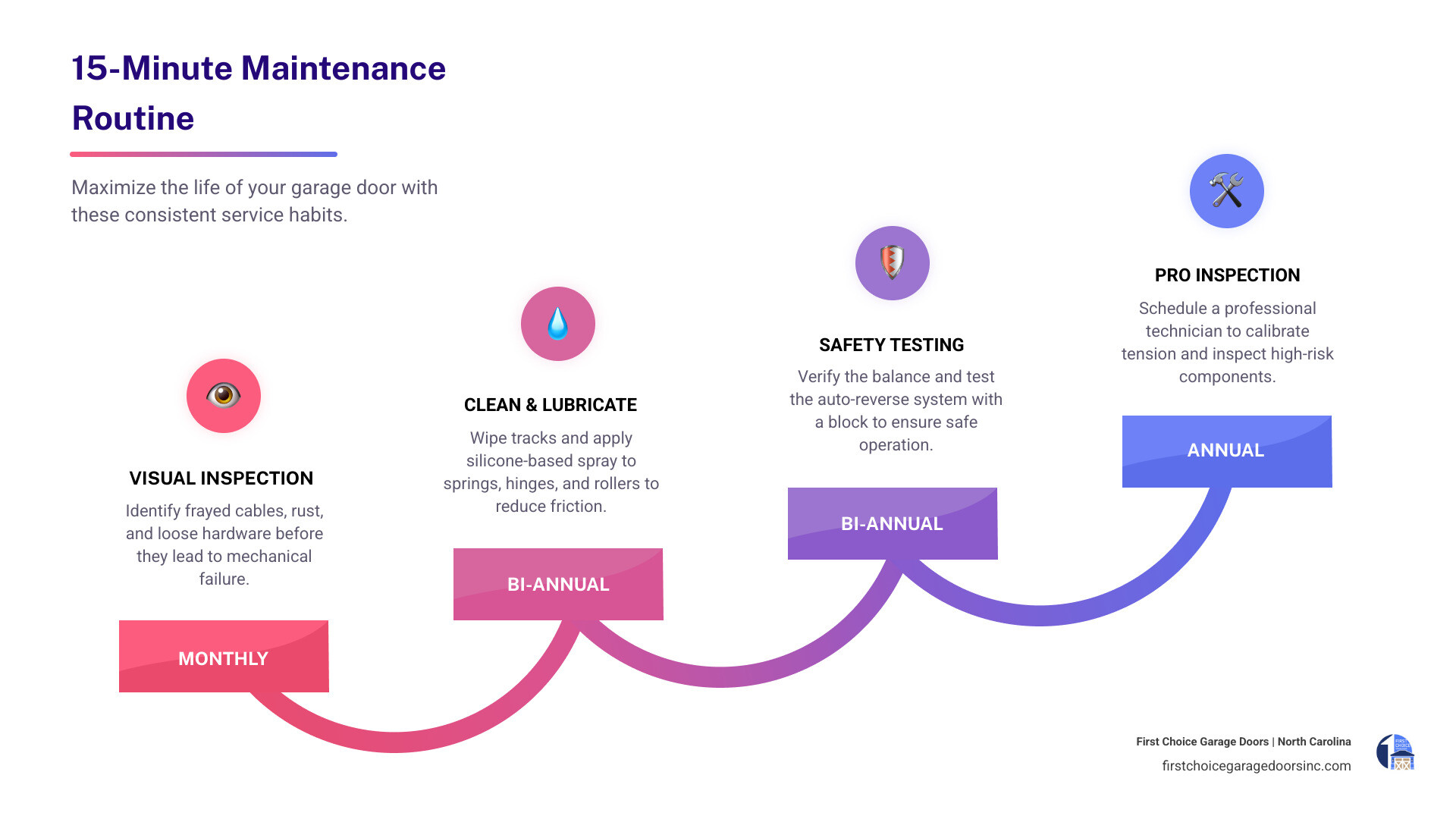
Here is a quick overview of the core maintenance tasks:
- Inspect monthly – Look for frayed cables, rust, loose hardware, and unusual sounds during operation
- Lubricate every 6 months – Apply silicone-based spray or white lithium grease to hinges, rollers, and springs
- Clean tracks regularly – Wipe with a damp cloth; never apply grease directly to tracks
- Test safety features – Check auto-reverse and photo-eye sensors at least twice a year
- Check door balance – Disconnect the opener and manually lift the door to waist height; it should hold in place
- Inspect weatherstripping – Replace cracked or torn seals before each winter season
- Schedule a professional inspection – At minimum once a year for springs, cables, and opener calibration
Your garage door is one of the largest and hardest-working moving parts in your home. The average door opens and closes 3 to 5 times a day — that adds up to roughly 1,500 cycles every year. Over time, that kind of wear puts real stress on springs, rollers, cables, and hardware. And yet, most homeowners never give it a second thought until something breaks.
The good news? With proper care, a garage door can last anywhere from 15 to 30 years depending on the material and how well it is maintained. Skipping that care, on the other hand, can turn a minor squeaky hinge into an off-track door or a snapped spring — repairs that are both costly and potentially dangerous.
I’m Tony Aguilar, founder of First Choice Garage Doors with over 30 years of hands-on experience helping homeowners understand how to maintain your garage door for long life and avoid unnecessary breakdowns. In this guide, I’ll walk you through everything you need to know — from monthly checks to seasonal care — so your door stays safe, quiet, and reliable for decades to come.
The Importance of Regular Upkeep for Your Home’s Largest Moving Part
It is easy to forget that your garage door is a massive mechanical system. In Fayetteville, NC, we use our garages for everything from car storage to home gyms and primary entry points. In fact, current 2026 data shows that 73% of North American homeowners use the garage as their main way into the house. This makes its reliability essential for your daily routine.
Beyond mere convenience, 3 Ways To Keep Your Garage Door In Good Repair directly impacts your property value. A well-maintained door enhances curb appeal and serves as a signal to future buyers that the home has been meticulously cared for. Conversely, a sagging, noisy door can be a major red flag.
Safety is perhaps the most critical reason for regular Garage Door Maintenance Tips To Ensure A Long Lasting Door. Because these doors weigh hundreds of pounds and operate under extreme spring tension, a failure can lead to property damage or serious injury. Furthermore, a door that seals tightly against the elements improves energy efficiency, potentially lowering your cooling costs during those humid North Carolina summers.
How to Maintain Your Garage Door for Long Life: A Step-by-Step Guide

The secret to Garage Door Maintenance isn’t about being a mechanical genius; it’s about observation. We recommend starting with a visual and auditory “walk-around.” Watch the door as it moves. Does it jerk? Does it make a grinding or scraping sound? These are early warning signs that components are working harder than they should.
One of the most effective Ten Residential Garage Door Maintenance Tips is hardware tightening. Because the door vibrates every time it opens, nuts and bolts naturally loosen over time. Every 4 to 6 months, take a socket wrench and ensure the roller brackets and bolts are snug. This reduces vibration and prevents parts from vibrating out of alignment.
Speaking of rollers, these are the “tires” of your garage door. You will need to replace your doors’ rollers about every seven years. If you see flat spots, cracks, or worn-down bearings, it’s time for a swap to prevent the door from jumping the track.
Proper Lubrication Techniques for Long Life
If hardware tightening is the “check-up,” lubrication is the “medicine.” However, using the wrong product can do more harm than good. A common mistake is using standard WD-40. While great for cleaning rust, WD-40 is a solvent, not a long-term lubricant. It can actually strip away existing grease and attract dust, creating a sticky mess.
Instead, follow these Garage Maintenance Tips:
- Use Silicone-Based Spray or White Lithium Grease: These stay “wet” longer and don’t attract as much debris.
- Lubricate the Springs: A light coating on the torsion spring (the large coil above the door) prevents rust and reduces the friction between coils as they wind and unwind. This can extend spring life by 20–30%.
- Pivot Points: Apply lubricant to all hinges where they bend and to the roller bearings.
- Opener Drive: If you have a chain or screw-drive opener, apply a small amount of white lithium grease to the rail. (Note: Belt drives do not require lubrication on the belt).
Cleaning and Track Care for Long Life
Many homeowners assume they should grease the tracks to make the door slide better. This is a myth! Tracks should be kept clean and dry. Grease in the tracks acts as a magnet for Fayetteville’s pine needles, dust, and spider webs, which eventually hardens into a “sludge” that can cause the door to stick or derail.
Check these Things To Look For When Maintaining Your Garage Door:
- Wipe the Tracks: Use a damp cloth to remove dirt and debris from the internal “lip” of the vertical and horizontal tracks.
- Sensor Cleaning: Wipe the photo-eye sensor lenses with a soft, dry cloth. Dust accumulation on these sensors accounts for nearly 40% of false-reversal service calls.
- Clear Obstructions: Ensure no brooms, shovels, or bikes are leaning against the tracks, as even a small bump can knock them out of alignment.
Essential Safety Tests and Hardware Inspections
Safety isn’t just a buzzword; it’s a requirement. Since 1993, federal UL 325 standards have mandated that all residential openers include safety reversal features. Keeping Up With Garage Door Maintenance involves testing these systems to ensure they actually work when a child or pet is in the way.
The “Halfway Lift Test” is the gold standard for Garage Door Maintenance Guide Annapolis Md. To do this, pull the emergency release cord (usually a red handle) to disconnect the opener. Manually lift the door halfway and let go. A perfectly balanced door will stay in place. If it shoots upward or crashes down, your springs are either too tight or too fatigued, putting immense strain on your opener motor.
While you are at it, inspect the lift cables. Look for “fraying” (broken strands of wire) near the bottom roller brackets. If a cable snaps while the door is moving, the door can fall with enough force to crush anything beneath it.
| Feature | Metal Rollers | Nylon Rollers |
|---|---|---|
| Noise Level | Loud/Clanging | Quiet/Smooth |
| Lubrication | Required on bearings | Often sealed (no lube needed) |
| Lifespan | 5-7 Years | 10-15 Years |
| Noise Reduction | Baseline | Up to 75% quieter |
Testing Safety Reversal Systems
There are two main safety systems to check. First, the Photo-Eye Sensors. While the door is closing, wave a broom handle through the invisible beam near the floor. The door should immediately stop and reverse.
Second, perform the Mechanical Reversal Test as suggested in our Garage Door Maintenance Tips To Follow This Spring. Place a flat 2×4 piece of wood or a sturdy cardboard box on the garage floor where the door would touch down. When the door hits the object, it should sense the resistance and reverse within two seconds. If it keeps trying to crush the object, your “force limits” need professional adjustment.
Seasonal Care and Weatherproofing Strategies
North Carolina weather can be unpredictable. Between the summer heat and the occasional winter freeze, your door’s rubber components take a beating.
- Summer Care: High UV exposure can make rubber brittle. Follow Garage Door Maintenance Tips For Summer by applying a rubber conditioner to the weatherstripping to keep it flexible.
- Winter Care: Cold weather causes metal to contract, which is when most spring failures occur. Garage Door Maintenance Tips For Winter should focus on ensuring the bottom seal isn’t frozen to the driveway, which can tear the rubber or burn out the opener motor when you try to open it.
- Fall Tasks: As part of your Fall Maintenance Tasks For Your Garage Door, do a “light leak test.” Close the garage door during the day, turn off the lights inside, and look for any daylight peeking through the edges. If you see light, you’re losing conditioned air and inviting pests inside.
Material-Specific Upkeep
Different materials require different “TLC.” If you have a natural wood door, you need to know How To Maintain A Wood Garage Door. Wood can swell in humidity and requires regular staining or painting to prevent rot.
For those with metal doors, Maintenance Tips For Your Aluminum Garage Door focus more on rust prevention. If you live in a coastal area or near a road where salt is used, rinse the exterior of the door with fresh water monthly to prevent corrosion. Steel doors should be washed with mild detergent and a soft brush every few months to maintain the finish.
When to Call a Professional for Garage Door Repairs
While we encourage homeowners to handle lubrication and cleaning, some tasks are strictly “Pro Only.” The Garage Door Repair industry has a life-saving rule: Never touch the red-painted components. Manufacturers paint bottom brackets and spring winding cones red to indicate they are under extreme mechanical tension.
If you see a visible gap in your torsion spring (as shown in the image above), the spring is broken. Do not attempt to pull the emergency release or operate the door, as it is no longer counterbalanced and can be incredibly heavy.
There are many reasons Why Get Garage Door Servicing Done During Summer. A professional tune-up includes things a DIYer cannot easily do, such as checking cable health inside the drums, calibrating the opener’s internal gears (which can turn into “white powder” if neglected), and ensuring the tracks are perfectly plumb using a level.
Frequently Asked Questions about Garage Door Longevity
How do I test if my garage door is properly balanced?
Disconnect the electric opener by pulling the red release cord. Manually lift the door to about waist height (3-4 feet) and let go. If the door stays in place or drifts only an inch or two, it is balanced. If it falls to the floor or “shoots” upward, the spring tension is incorrect and needs a professional adjustment.
What is the best lubricant for garage door parts?
The best choice is a dedicated garage door lubricant, typically a silicone-based spray or white lithium grease. These products are designed to withstand extreme temperature changes without becoming gummy. Avoid petroleum-based oils or WD-40, as they attract grit that wears down metal parts faster.
How often should I perform garage door maintenance?
We recommend a “Three-Tiered” approach:
- Monthly: 3-minute visual and auditory check.
- Bi-Annually (Spring/Fall): Full lubrication, hardware tightening, and safety reversal tests.
- Annually: A professional inspection to catch “hidden” issues like internal gear wear or cable fraying inside the drums.
Conclusion
At First Choice Garage Doors, we’ve seen how a little bit of prevention goes a long way. How to maintain your garage door for long life isn’t just about saving money on a repair bill; it’s about the peace of mind that comes from knowing your home is secure and your family is safe.
Whether you are in Fayetteville, NC, or any of our other service areas, our expert technicians are here to help. If your door is making strange noises or failed the balance test, don’t wait for a total breakdown. Contact us today for professional Garage Door Maintenance and let us help you get the full 30-year life out of your garage door system.